At a Glance: University of Toronto Key Data 2026
| Metric | 2026 Data |
|---|---|
| QS World University Ranking 2026 | 21st globally, 1st in Canada |
| Times Higher Education 2026 | 22nd globally |
| Total enrollment | ~97,000 (undergraduate & graduate) |
| International student share | 29% |
| Campuses | St. George, Mississauga (UTM), Scarborough (UTSC) |
| Rotman Commerce acceptance rate | ~17% |
| Rotman BCom international tuition (2026–27) | CAD $61,350 per year |
| U of T research income (2025–2026) | Over CAD $1.4 billion |
| PGWP eligibility | Yes, up to 3 years |
The Three Campuses: Which One Fits Your Goals?
The University of Toronto is not a single-site institution. It offers three distinct undergraduate campuses, each with its own academic strengths, culture and location in the Greater Toronto Area. All three grant the same University of Toronto degree and share core quality standards, but your experience will vary significantly depending on which campus you choose.
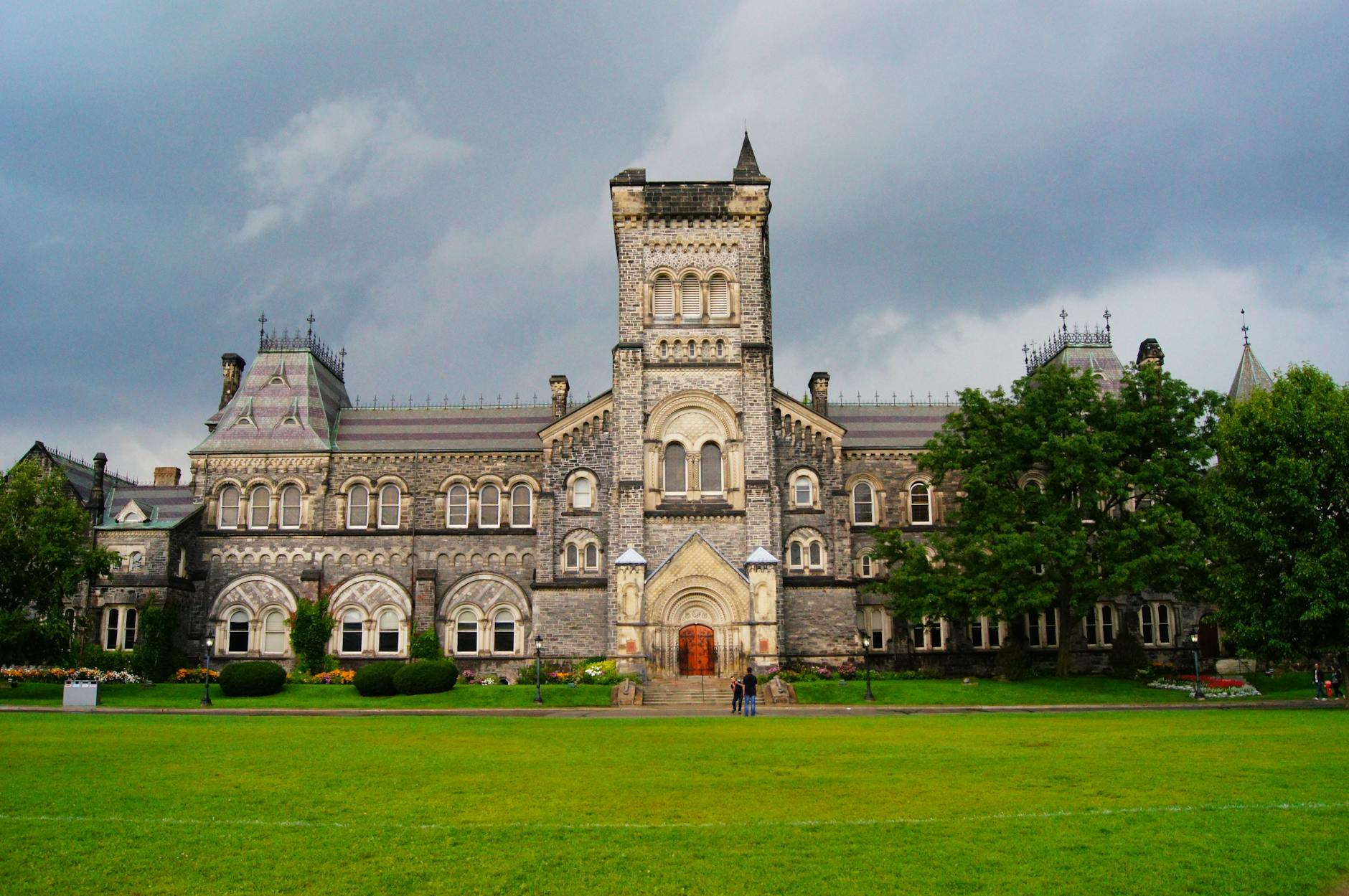
- St. George (Downtown Toronto): The historic core and largest campus, home to Rotman Commerce, the Faculty of Arts & Science, Engineering, and the majority of professional faculties. It sits in the heart of Canada’s financial and cultural capital, giving business students instant access to internship opportunities at Bay Street banks, consulting firms and tech companies. About 64,000 students study here. Residence options include Trinity, Victoria, University College and several others.
- Mississauga (UTM): Located 33 km west of downtown, UTM enrolls roughly 15,000 students and is known for its modern facilities, strong management programs, and forensic science. The Institute for Management & Innovation provides a business education path that some students treat as a smaller alternative to Rotman Commerce.
- Scarborough (UTSC): About 14,000 students study on this eastern campus, which pioneered the co-op model within U of T. UTSC offers a BBA in Management and International Business that includes mandatory co-op work terms, giving graduates a full year of paid work experience before finishing their degree.
International students are well represented across all three campuses. UTM and UTSC tend to offer a more contained campus experience with faster peer integration, while St. George provides unmatched breadth but can feel overwhelming in first year.
Rotman Commerce in 2026: Admissions, Curriculum and Career Outcomes
Rotman Commerce is consistently ranked as a top-3 business program in Canada. Its Bachelor of Commerce program admitted around 17% of applicants in the 2025–2026 cycle, a figure that reflects both the program’s popularity and its competitive entry requirements.
Q: What are the admission requirements for Rotman Commerce in 2026?
For Ontario high school students, the minimum competitive average sits in the high 80s, but successful applicants often present low-to-mid 90s across their top six Grade 12 subjects, including English (ENG4U) and Calculus & Vectors (MCV4U). British-pattern A-Level applicants typically need A*AA, including Mathematics. IB applicants need a score of 36–38 with 6 in HL Mathematics. English proficiency requires IELTS Academic 6.5 (minimum 6.0 in each band) or TOEFL iBT 100+ (with 22+ in writing). Crucially, all applicants must complete the Rotman Commerce Supplemental Application, which records a timed video interview and a short written response. This component frequently makes or breaks borderline candidates.
Curriculum structure
The four-year BCom divides into two phases. Years one and two build foundational knowledge in economics, finance, accounting, statistics, and management. In years three and four, students specialize in one of three streams: Accounting, Finance & Economics, or Management. The program also requires courses in communication and strategy specifically designed for Rotman Commerce students.
Career outcomes
Rotman Commerce’s 2025 employment report (data published in 2026) shows that 92% of graduates were employed within six months. Median starting salary is CAD $66,000, with top-quartile earners reaching above CAD $80,000. Key hiring firms include RBC, TD, Scotiabank, Deloitte, PwC, McKinsey, and Amazon. The program’s location on the St. George campus means students can network at employer events without commuting.
U15 Research Power and Why It Matters for Undergraduates
The U15 Group of Canadian Research Universities represents Canada’s 15 most research-intensive institutions. Together, they account for nearly 80% of all competitive university research funding in the country. In 2025–2026, U15 members collectively received an estimated CAD $9.5 billion in sponsored research income, and the University of Toronto alone captured more than CAD $1.4 billion of that total.
Why should an undergraduate or future applicant care about research numbers? Three tangible reasons stand out in 2026:
- Undergraduate research placements: U of T’s Research Opportunity Program, work-study positions, and NSERC Undergraduate Student Research Awards let you work in a lab or on a faculty-led project as early as your second year. Gaining this experience strengthens graduate school and scholarship applications.
- Faculty quality: Research funding correlates with the university’s ability to recruit and retain faculty who are leaders in their fields – Nobel laureates, Turing Award winners, and Canada Research Chairs frequently teach undergraduate courses at U of T.
- Facilities and resources: High research income supports state-of-the-art libraries, data labs, and innovation hubs that undergraduates access daily.
For Rotman Commerce students, U15 membership also feeds into the business school’s research centers, such as the Behavioral Economics in Action research hub, whose insights often filter directly into classroom case studies.
Tuition, Living Costs and Scholarships in 2026
Studying at the University of Toronto as an international student requires a substantial financial plan. Below are estimated annual costs for the 2026–2027 academic year in Canadian dollars.
| Expense category | Rotman Commerce (BCom) | Arts & Science | Engineering |
|---|---|---|---|
| Tuition (international) | $61,350 | $60,000 | $67,400 |
| On-campus residence + meal plan | $17,500–$20,000 | Same | Same |
| Books, supplies & health insurance | $3,000 | $3,000 | $3,000 |
| Personal expenses & transport | $4,500 | $4,500 | $4,500 |
| Total estimated annual cost | $86,350–$88,850 | $85,000–$87,500 | $92,900–$94,900 |
Q: How much does it cost to study at the University of Toronto as an international student in 2026?
All-in cost ranges from approximately CAD $85,000 to $95,000 per year, depending on your program. Rotman Commerce international tuition is CAD $61,350, and other costs push the total toward CAD $88,000. Mississauga and Scarborough campus programs often have slightly lower ancillary fees, but core tuition remains in the same ballpark.
Scholarships that make a difference
The University of Toronto International Scholar Award and the Lester B. Pearson International Scholarship are the two flagship entry points for financial support. The Pearson Scholarship covers tuition, books, incidental fees and residence for four years, and is granted to about 37 students per year globally. Applicants must be nominated by their high school. U of T also offers automatic entrance scholarships based on academic performance; international students are considered for these, though amounts are smaller – typically CAD $5,000–$10,000.
Post-Graduation Work Permits and Immigration Pathways in 2026
Graduates of the University of Toronto enjoy work and immigration advantages that make the upfront investment easier to rationalize.
Q: Is the University of Toronto eligible for a Post-Graduation Work Permit?
Absolutely. All U of T undergraduate programs are PGWP-eligible. A bachelor’s degree of four years leads to a three-year open work permit. You do not need a job offer to apply. The Government of Canada’s 2026 PGWP rules continue to honor this pathway for designated learning institutions like U of T.
Toronto’s economy is Canada’s largest, with more than 40% of the country’s financial services employment and a rapidly expanding tech corridor. Rotman Commerce graduates routinely land positions at big five banks, pension funds, and multinational firms within months of finishing. Co-op graduates from UTSC have an especially fast track into the workforce.
From a permanent residency standpoint, IRCC’s 2026–2028 Immigration Levels Plan targets 485,000 new permanent residents annually in 2026 and 500,000 in 2027 and 2028. A Canadian degree and one year of skilled work experience on a PGWP put you in a strong position for Express Entry under the Canadian Experience Class. Many U of T international alumni transition from temporary worker to permanent resident within three years of graduation.
Frequently Asked Questions
Q: What is the difference between Rotman Commerce and the Rotman School of Management?
Rotman Commerce is the Bachelor of Commerce program for undergraduates, jointly run by the Faculty of Arts & Science and the Rotman School. The Rotman School of Management is the graduate division offering MBA, Master of Finance, Master of Management Analytics, and PhD programs. You do not need work experience for Rotman Commerce; full-time MBA admission typically requires at least two years of professional experience.
Q: Is Toronto safe for international students?
Yes. Toronto consistently ranks as one of the safest large cities in North America. The 2026 Safe Cities Index by The Economist placed Toronto in the top 10 globally. The University of Toronto offers 24/7 campus security, a safety app, and a walk-safe program. Like any major city, awareness at night is wise, but violent crime rates remain low.
Q: Can I transfer between U of T campuses?
Transfers are possible but not automatic. Each campus has its own competitive internal transfer processes, and moving into programs like Rotman Commerce from UTM or UTSC is restricted because Rotman Commerce is only offered at St. George. It is generally easier to transfer between non-professional programs within the same faculty. Consult each campus’s registrar office for the latest 2026 transfer policies.
References
- University of Toronto Future Students – Programs and fees: https://www.utoronto.ca/future-students (Official enrollment, tuition and admission information, updated for 2026 intake)
- QS World University Rankings 2026: https://www.topuniversities.com/university-rankings/world-university-rankings/2026 (Third-party global ranking confirming U of T’s 21st position)
- U15 Group of Canadian Research Universities – Data and publications: https://u15.ca (Official research funding aggregates and policy updates for 2025–2026)
- Immigration, Refugees and Citizenship Canada – 2026–2028 Immigration Levels Plan: https://www.canada.ca/en/immigration-refugees-citizenship.html (Authoritative source for PGWP rules and permanent residency targets)