TL;DR: What You Need to Know About Columbia University in 2026
Columbia University (컬럼비아대학교) remains one of the most competitive Ivy League (아이비리그) destinations for Korean students in 2026. The university admits around 120 Korean undergraduates annually, with an overall acceptance rate of 3.9% for the Class of 2030. Annual tuition and fees total $68,400, but Columbia meets 100% of demonstrated need for all admitted students, including internationals; Korean students who qualify for need‑based aid receive average grants of $62,800. Meanwhile, the famous Core Curriculum (코어 커리큘럼) offers a liberal‑arts foundation that Korean employers value, particularly in areas like critical thinking and English fluency. Living in New York (뉴욕 유학) adds another $22,000–$26,000 in living costs, though campus‑adjacent neighborhoods like Morningside Heights are relatively affordable. Korean‑specific external scholarships (장학금) from the Korea Student Aid Foundation and conglomerates like Samsung further reduce the net cost. This guide breaks down admissions data, Core requirements, scholarship realities, and day‑to‑day life in Manhattan.
Data‑Driven Snapshot: Columbia University & Korean Students (2026)
| Metric | Figure | Source |
|---|---|---|
| Overall acceptance rate | 3.9% (Class of 2030) | Columbia Office of Undergraduate Admissions, 2026 |
| Korean undergraduate enrollment | ~120 students | Columbia International Students & Scholars Office, 2026 |
| Annual tuition & fees | $68,400 | Columbia Student Financial Services, 2026‑27 |
| Average need‑based grant (international students) | $63,000 | Columbia Financial Aid, 2026‑27 |
| Estimated living costs (room & board + personal) | $22,800 – $26,400 | Columbia Undergraduate Housing & Dining, 2026 |
| Core Curriculum courses required | 10 mandatory classes | Columbia College Bulletin, 2026 |
| Typical Korean external scholarship award | $10,000 – $50,000/year | Korea Student Aid Foundation (KOSAF) & corporate programs |
| Median starting salary for Columbia grads (global) | $82,000 | Columbia Center for Career Education, 2025 graduate survey |
1. The Core Curriculum: How Korean Students Benefit from 코어 커리큘럼
Columbia’s Core Curriculum (코어 커리큘럼) has defined the undergraduate experience since 1919. In 2026, all Columbia College and School of Engineering students must complete between 8 and 10 foundational courses that span literature, philosophy, history, art, music, and science. The mandatory sequence includes:
- Literature Humanities (Lit Hum): a year‑long reading of Western classics from Homer to Virginia Woolf.
- Contemporary Civilization (CC): a year‑long examination of political and moral philosophy.
- University Writing: an intensive writing seminar centered on academic research.
- Art Humanities & Music Humanities: one semester each, focusing on visual and musical masterpieces.
- Frontiers of Science: a semester‑long exploration of scientific reasoning.
- Two Global Core courses that address non‑Western cultures.
- Two physical education requirements and a swim test.
For Korean students, the Core delivers a distinct advantage. First, University Writing and the discussion‑based structure of Lit Hum and CC rapidly accelerate English writing and speaking skills – a common challenge for Korean learners. Second, the broad intellectual training is highly valued by Korean corporate employers and graduate schools; firms like Samsung and LG increasingly seek liberal‑arts graduates who can think across disciplines. Third, the small class sizes (22 students per section) create a tight‑knit community that helps international students adjust.
According to a 2026 survey by Columbia’s Office of Global Programs, Korean alumni frequently cite the Core as the most transformative part of their education, noting that it built the confidence to analyze complex texts and participate in high‑level discussions – skills directly transferable to Seoul’s competitive job market.
2. Manhattan Campus Life: 뉴욕 유학 and the Columbia Experience
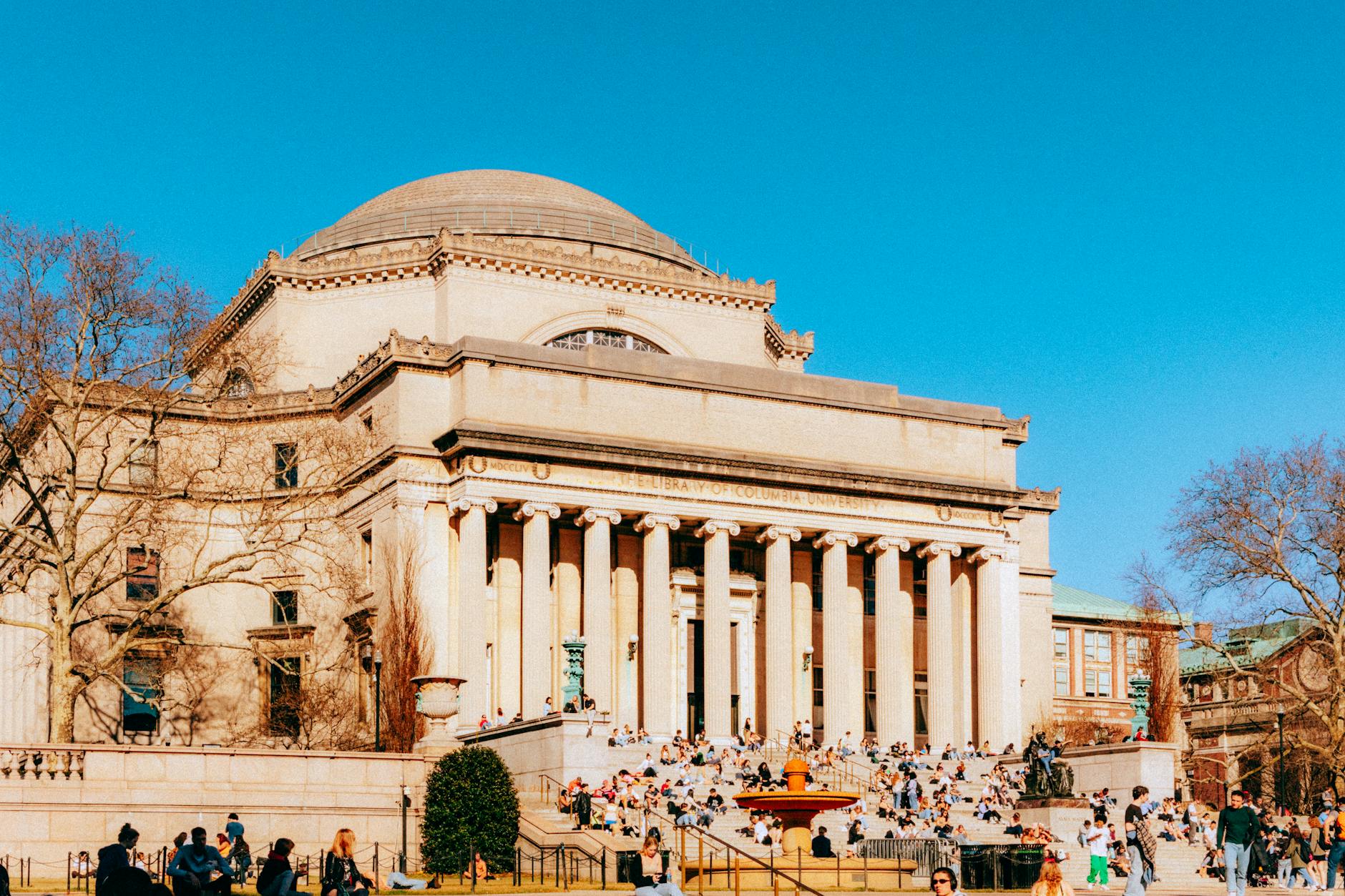
Columbia’s main campus occupies 36 acres in Morningside Heights, a residential enclave on the Upper West Side of Manhattan. In 2026, the campus is a 15‑minute subway ride from Midtown and a 30‑minute ride from Koreatown on 32nd Street. This location shapes the entire study‑abroad experience for Korean students.
Housing and Dining
First‑year students are guaranteed on‑campus housing. Options range from traditional corridor‑style residence halls to suite‑style apartments. In 2026‑27, the average room charge is $11,200 per year, with a meal plan adding another $5,600. Off‑campus rentals nearby typically cost $1,800–$3,000 per month for a studio; many Korean upperclassmen share apartments in Flushing, Queens, or Fort Lee, New Jersey, where Korean‑language groceries and restaurants are abundant.
Safety and Community
Morningside Heights is one of the safer neighborhoods in Manhattan, with a 24‑hour campus security escort service. Columbia’s Korean Students Association (CUSA) is one of the largest cultural organizations on campus, hosting weekly events, career panels with Korean‑American professionals, and mentorship programs. In 2026, CUSA registered over 250 active members, including both undergraduate and graduate students.
Cultural Vibe
Living in New York (뉴욕 유학) means access to world‑class museums, Broadway shows, and a global gastronomy scene. Korean students appreciate the city’s K‑town, which has grown to nearly three blocks of Korean restaurants, bakeries, and karaoke bars. The campus itself blends Gothic architecture with modern facilities, including the newly‑renovated Uris Hall and the forthcoming Columbia Business School buildings.
3. Scholarships and Financial Aid for Korean Students (장학금)
Columbia is need‑aware for international applicants, meaning financial need is considered during admissions. However, once admitted, the university meets 100% of demonstrated financial need through grants and work‑study, without loans. In 2026‑27, the financial aid formula for international students relies on the CSS Profile and requires detailed family income and asset documentation. Korean students who receive aid are typically from families with annual incomes below $150,000, though need determination evaluates multiple factors.
Institutional Aid
- Average need‑based grant for international students: $63,000
- Percentage of international undergraduates receiving aid: 49%
- Maximum grant can cover full tuition plus partial living expenses.
External Scholarships (장학금) for Korean Nationals Korean students can stack Columbia’s aid with external scholarships. The most popular are:
| Scholarship | Award Range | Key Requirements |
|---|---|---|
| Korea Student Aid Foundation (KOSAF) Overseas Study Loan | Up to $20,000/year loan | Korean citizenship, enrollment at accredited four‑year institution |
| Samsung Global Scholarship Program | Full tuition + stipend | Acceptance to top‑20 U.S. university, return‑service obligation |
| LG Global Challenger | $15,000–$30,000 merit award | STEM or business majors, strong GPA |
| Hyundai Motor Group Global Scholarship | $25,000/year | Engineering or design fields |
| Iljin Overseas Scholarship | Up to $50,000 | Science/engineering focus, commitment to work in Korea |
| Korean‑American Scholarship Foundation (East Region) | $2,000–$5,000 | Korean heritage (including Korean nationals studying in U.S.) |
Key Deadline : Most external applications close between March and July for the upcoming academic year. Korean students should begin preparing scholarship essays in January, well before Columbia’s financial aid deadline.
4. Admission Requirements and Tips for Korean Applicants
Columbia uses a holistic review process. In 2026, the following baseline numbers shape admissions for Korean students:
- Standardized Tests: Columbia remains test‑optional through 2026‑27, but 65% of admitted Korean applicants submitted SAT or ACT scores. The middle 50% SAT range was 1510‑1560; ACT composite 34‑35.
- English Proficiency: Required unless you have attended an English‑medium school for four years. Minimum TOEFL iBT 105 (recommended 112+) or IELTS 7.5 (recommended 8.0).
- High School Curriculum: Korean applicants typically present a strong mix of the Korean high school curriculum or IB/AP courses. Successful profiles often include at least three AP exams with scores of 5.
- Essays & Recommendations: Columbia requires the Common Application personal essay plus two Columbia‑specific supplements: one “Why Columbia?” and one list of books/media that have influenced you. Korean applicants who connect the Core Curriculum (코어 커리큘럼) to their intellectual interests tend to stand out.
- Interview: Alumni interviews are offered but not required. Only 15% of Korean applicants receive an interview invitation due to limited alumni in the region; lack of an interview does not hurt your chances.
Korean‑Specific Strategy:
Many Korean students highlight extracurriculars like music (piano/violin), volunteer work, or leadership in school clubs. Because Columbia values “intellectual curiosity,” successful essays often discuss a cross‑disciplinary project—for example, applying AI to traditional Korean calligraphy—rather than simply listing achievements.
5. Career Outcomes and the Ivy League Network (아이비리그)
An Ivy League (아이비리그) diploma from Columbia opens doors globally. 2025 graduate survey data shows that 72% of international students, including Koreans, secured employment within six months of graduation, with another 18% pursuing advanced degrees. The median starting salary across all graduates was $82,000, rising to $95,000 for engineering and computer science majors.
Top industries for Korean graduates:
- Finance & Banking (Goldman Sachs, J.P. Morgan, Samsung Securities)
- Technology (Google, Samsung Electronics, Naver, Kakao)
- Consulting (McKinsey, Bain, BCG)
- Media & Entertainment (Netflix, CJ ENM)
- Government & Public Policy (UN, Korean Ministry of Foreign Affairs)
Columbia’s Center for Career Education maintains a dedicated Korea‑focused recruitment pipeline. In 2026, at least 15 Korean companies conducted on‑campus or virtual recruitment sessions, including the Korea Trade‑Investment Promotion Agency (KOTRA) and the Korea International Trade Association. The alumni network in Seoul numbers over 2,000, with active chapters hosting regular networking events.
FAQ
Q: What is the Columbia Core Curriculum and how does it benefit Korean students?
The Core Curriculum (코어 커리큘럼) is a mandatory set of liberal arts courses that all Columbia undergraduates take. It covers Western philosophy, literature, art, music, and science. Korean students gain rapid improvement in academic English, critical thinking, and cross‑cultural communication – skills that Korean employers and graduate programs prize. Small discussion classes also ease the social transition to a U.S. university.
Q: How much scholarship (장학금) can a Korean student realistically receive at Columbia?
Columbia meets 100% of demonstrated need. In 2026‑27, the average grant for international students is $63,000, and many Korean students receive packages covering full tuition. Additionally, Korean students can apply for external 장학금 from KOSAF, Samsung, LG, Hyundai, and other organizations, often ranging from $10,000 to $50,000 per year. However, Columbia is need‑aware, so a very high financial need may affect admissions chances.
Q: Is it better to live on or off campus in 뉴욕 유학 for a Korean undergraduate?
Most Korean freshmen and sophomores choose on‑campus housing in Morningside Heights for its safety, convenience, and community building. On‑campus room and board costs about $16,800 annually. Juniors and seniors often move to off‑campus apartments in Queens or New Jersey to save money—monthly rents can drop to $1,200 per person when sharing. The Korean Students Association provides a guide to finding housing near Korean markets and transit lines.
Q: How competitive is admission to Columbia for Korean students compared to other Ivy League schools (아이비리그)?
Columbia’s 3.9% acceptance rate in 2026 makes it one of the most selective Ivies, similar to Harvard and Yale. For Korean applicants, the admit rate may be slightly lower because of the large applicant pool from East Asia. Strong academics, distinctive essays, and a clear connection to Columbia’s Core Curriculum (코어 커리큘럼) are essential.
Q: Do Korean students need to take the SAT for Columbia in 2026?
Columbia remains test‑optional for the 2026‑27 admission cycle. However, 65% of admitted Korean applicants submit SAT or ACT scores, with successful scores typically in the top 5%. If your school offers standardized tests and you can take them safely, a strong score can strengthen your application, but a holistic review means essays and recommendations carry significant weight.
References
- Columbia University Office of Undergraduate Admissions, Class of 2030 Profile – https://undergrad.admissions.columbia.edu/class‑profile-2030 (official acceptance rate, standardized test ranges, enrollment data)
- Columbia Student Financial Services, 2026‑2027 Cost of Attendance – https://sfs.columbia.edu/content/cost‑attendance (tuition, fees, room and board figures, financial aid policy for international students)
- Columbia College Bulletin, Core Curriculum 2026 Edition – https://bulletin.columbia.edu/columbia‑college/core‑curriculum/ (detailed course requirements and descriptions)
- Columbia International Students & Scholars Office, 2026 Statistical Report – https://isso.columbia.edu/statistics (international student enrollment by country, Korean student count)
- Korea Student Aid Foundation (KOSAF), Overseas Study Loan Program 2026 – https://www.kosaf.go.kr/eng/jsp/student/loan/overseasStudyLoan.jsp (Korean government loan terms, eligibility)
- Samsung Global Scholarship Program, 2026 Announcement – https://www.samsungfoundation.org/global‑scholarship (corporate scholarship details, award amounts)